Welcome to the certification quiz.
This quiz has questions from all three courses.
1: Social Media
2: AI Literacy and Misinformation
3: Racial & Ethnic Bias in AI
Please complete all questions. The certificate will be emailed to you.
What is the recommended age to start using social media platforms like Facebook or Instagram?
Most social media platforms have a minimum age requirement due to the Children's Online Privacy Protection Act (COPPA) which restricts the collection of personal information from children under the age of 13.
Emily wants to create a password for her social media account. Which one should she pick?
Strong passwords can prevent anyone from accessing your social media sites, changing your personal information, or posting messages under your name.
How often should you update your privacy settings?
You should review and update your privacy settings regularly, especially when the social media platform recommends or when there is an update to the app.
Will you still get friend requests if your account is private?
Think of your social media account as your locker or backpack, who would you give access to?
What is a good example of strong privacy settings?
When updating privacy settings consider who you want to see your posts, who can send requests, what information you want public, and who can tag you.
Should Emily share a lot about her daily life on social media?
Sharing everything about your daily life can be risky, as it can offer strangers an in-depth insight into your routines, location, and more. Always consider your privacy and security.
Emily's friend is being bullied online. What should she do?
Be a good friend. Encourage them to come forward and reach out to an adult for support without hesitation.
Do not engage with the bully on your friend’s behalf.
Don’t be a bystander and stay on the sidelines but rather act as an upstander who helps find a solution.
If you posted something online but deleted it within 5 minutes, its gone forever. Is this True or False?
Be cautious when posting anything online. Posts can often be misinterpreted and are usually permanent, even if deleted. They can be screenshotted or archived, posing a potential risk.
What should I consider before downloading an app?
Discuss the app and why you want it with your parents. Some apps might seek access to more information than necessary for malicious purposes.
How can I benefit from social media?
Select all that apply
Decide a purpose of using the particular social media platform.
Focus on quality over quantity. Avoid mindless scrolling.
What are some examples of Artificial Intelligence (AI)?
AI refers to the simulation of human intelligence in machines that are programmed to think and learn like humans.
The term can also be applied to any machine that exhibits traits associated with a human mind such as learning and problem-solving.
This is an image of Selena Gomez at the MET Gala. Is it true or a deepfake?
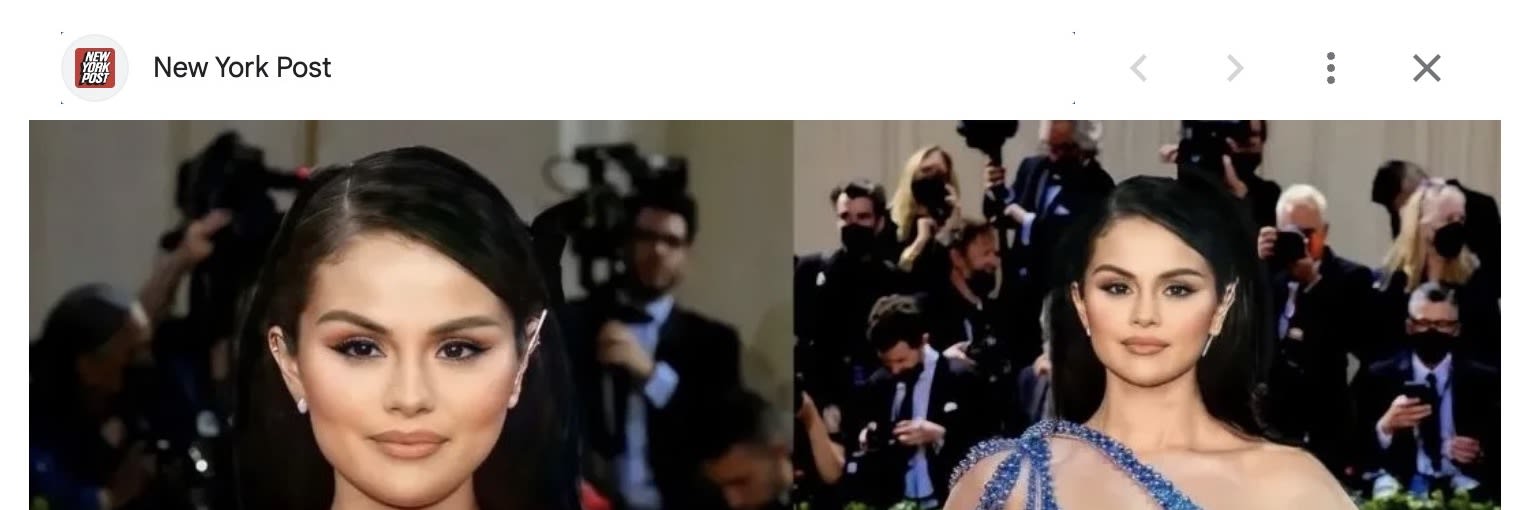
Deepfakes are synthetic media where an existing image or video is manipulated and can depict someone appearing to say or do something that they have not.
Deepfakes created using AI technologies can be very convincing.
What is the definition of misinformation?
Misinformation is false or inaccurate information that is spread unintentionally. It is different from disinformation, which is deliberately misleading or deceptive.
Can AI give out wrong answers?
Yes! Generative AI like ChatGPT and Google Bard may sometimes provide incorrect answers, especially in logical reasoning tasks, due to limitations in understanding context or applying logical principles.
Getting your homework answers from AI may not always work.
What is media literacy?
Media literacy involves the ability to critically evaluate sources and analyze media messages as well as create, reflect, and take action, using the power of information and communication to make a difference in the world.
It promotes curiosity about the media we consume and create.
How can we combat AI-driven misinformation online?
Combating AI-driven misinformation online involves educating individuals about media literacy, encouraging verification of information, and promoting critical thinking skills to discern credible sources.
Emily receives a message on social media claiming a new planet has been discovered in the solar system. What should she do?
Research the claim and check reliable sources for confirmation before sharing any information. This promotes critical thinking and helps prevent the spread of false information.
Emily is researching a topic online and finds unbelievable information. What should he do?
Check multiple sources to verify the accuracy of the information and ensure you get a comprehensive understanding of the topic. This helps him make informed decisions based on reliable information.
What is the definition of implicit bias?
The correct answer is B) Biases that are unintentionally held. Implicit bias refers to biases that individuals hold unconsciously, often influenced by societal stereotypes and attitudes, which can impact their judgments and behaviors.
How does bias affect behavior towards others?
Bias affects behavior towards others by influencing thoughts and actions (Option B). Individuals may unconsciously treat others unfairly or differently based on biases they hold, impacting how they interact and engage with others in various social contexts.
Thank you for completing this Quiz. You got {number correct}/{number of questions} correct answers.
Thank you for completing this Quiz. You got {number correct}/{number of questions} correct answers.
You did great but still need some work, please go through the modules again and appear for the quiz again.
Thank you for completing this Quiz. You got {number correct}/{number of questions} correct answers.
Hurrraaayyyy!!! You passed with flying colors.
Go back to the home page. https://www.cybersmartteens.com